1
Semantic proximity often tracks institutional function more clearly than literal wording, especially in rights catalogues and judicial-review provisions.
A global semantic map of constitutional law
Explore how AI-assisted semantic comparison can surface institutional patterns across the world's constitutions without reducing the analysis to keyword matching.
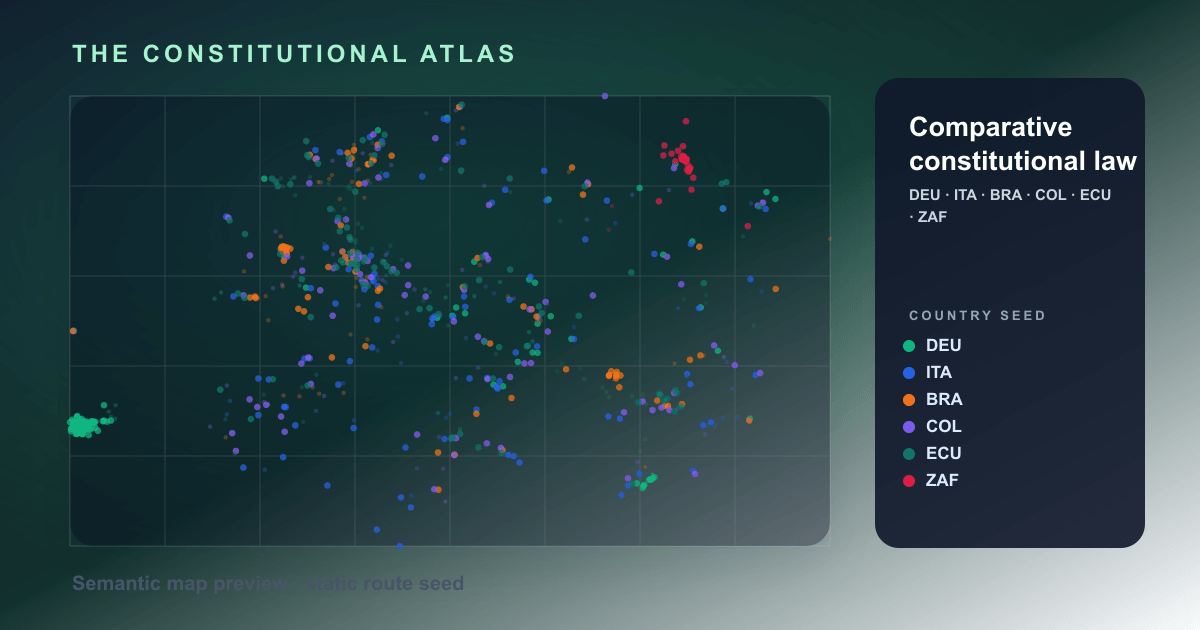
Comparative constitutional law
It lets researchers test constitutional functions across languages and drafting styles. Instead of asking only whether the same phrase appears, the Atlas asks which provisions behave similarly in the global semantic space.
Research context
This English hub points to narrower discovery pages for semantic search, country-pair comparison, structural themes, and bloc-level research questions.
The Atlas is not a substitute for legal interpretation. It is a triage layer that helps scholars decide which countries, clusters, and provisions deserve close reading first.
Three findings to test
Semantic proximity often tracks institutional function more clearly than literal wording, especially in rights catalogues and judicial-review provisions.
Country comparison works best when the first map state is small enough to inspect: two or three constitutional traditions before a wider bloc view.
The strongest SEO and research pages are not product explanations; they are narrow constitutional questions with a reproducible Atlas state.
Method note
Treat the map as a research instrument. It ranks and visualizes similarity, but doctrinal conclusions still require reading the relevant constitutional text and legal context.
Related discovery pages
Use semantic search to find constitutional provisions about environmental rights, due process, dignity, and institutional design across different drafting traditions.
Country comparisonCompare how Germany and Italy protect constitutional identity from ordinary amendment, with Brazil added as a third reference point.
ThemeCompare how constitutions protect environmental quality, health, natural resources, and duties toward future generations.